

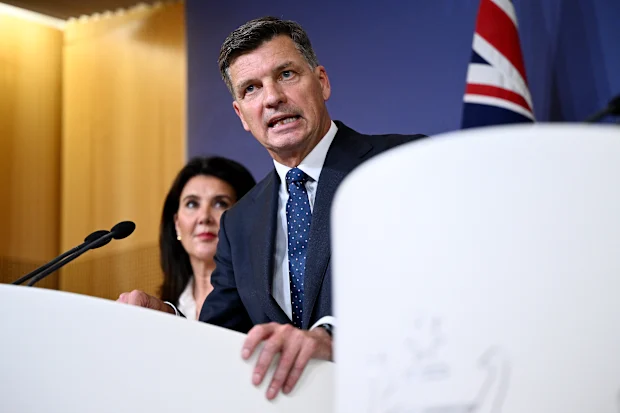
In a major political shake-up, Coalition Leader Angus Taylor has unveiled what he calls the “biggest cut to migration in Australia’s history”. Under the sweeping proposal, a Coalition government would drastically curtail temporary visa intake, cap net overseas migration, and introduce stringent welfare access rules.
The policy signals a significant rightward pivot in Australian federal politics, sparking sharp pushback from Labor, business sector groups, and humanitarian advocates.
At a Glance: Key Targets in the Coalition Migration Policy
650,000 Temporary Visas Cut: The policy aims to reduce the pool of temporary visa holders by over a third over four years.
Net Migration Cap: Net overseas migration would be slashed to 100,000 annually for the first two years of government.
Bridging Visas Slashed: Bridging and temporary protection figures would drop dramatically to 20,000 (down from over 400,000).
50% Humanitarian Reduction: Humanitarian refugee intake would be halved to 10,000 places.
Welfare Access Overhaul: Centrelink and government payment benefits would be restricted exclusively to Australian citizens for new arrivals.
Detailed Policy Breakdown
1. Temporary Visas & Student Reforms
The main target of the Coalition’s plan is temporary migration. The proposed framework ties overall overseas arrivals directly to local housing completions and tightens student visa conditions by linking each visa strictly to the enrolling educational institution.
2. Skilled & Sector Specific Intake
While temporary numbers face massive cuts, the Coalition promises to maintain the permanent skilled migration baseline at 185,000 places annually. To address specific labor shortages, the plan introduces:
A dedicated strike force to clear construction visa backlogs.
A doubled talent allocation (7,000 places) under a new AUKUS and Five Eyes pathway.
A planned agricultural visa starting from 2030.
3. Tightened Welfare Restrictions
To “make citizenship count,” the proposed policy blocks temporary and provisional residents from accessing 17 federal government benefit streams, reserving those payments strictly for Australian citizens. Existing recipients would be grandfathered under current rules.
Political & Economic Backlash
| Perspective | Key Concerns / Standpoint |
| Labor Government | Labelled the policy “catastrophic,” arguing it risks exacerbating skill shortages and using migrants as political fodder. |
| One Nation | One Nation figures, including Pauline Hanson, noted the center of political debate has shifted, while questioning whether the Coalition will follow through. |
| Business & Advocates | Industry leaders warn that rapid visa reductions could breach international agreements (such as trade terms with India) and damage core sectors reliant on temporary talent. |
The policy announced by Coalition Leader Angus Taylor centers on slashing Net Overseas Migration (NOM) to 100,000 annually for two years (eventually scaling to 160,000), down from the 250,000+ levels under Labor.
This target heavily reshapes two core areas: housing supply and affordability and the international education sector.
1. Impact on Housing & Regional Infrastructure
Immediate Demand Relief vs. Supply Dynamics
Taking Pressure Off Rental Markets: By cutting temporary visa numbers by approximately 650,000 over four years, the Coalition aims to immediately reduce competition in tight inner-city and regional rental markets.
Tying Migration to Housing Completions: Under the proposed framework, broader overseas migration targets are directly linked to local residential construction rates, ensuring population growth matches available dwelling stock.
Construction Labor Exception: To prevent housing supply bottlenecks, the plan introduces a 15,000 Skilled Project Visa stream and a dedicated strike force to clear backlogs for construction and trades workers.
Regional Nuances & Challenges
Labor Shortages in Regional Hubs: While lower population inflow reduces demand for regional rentals, regional healthcare, agriculture, and hospitality providers rely heavily on temporary and working holiday visa holders. Reductions could exacerbate workforce deficits in non-metropolitan centers.
Capital City Shift: Because temporary visa holders overwhelmingly cluster in major metropolitan areas (Sydney, Melbourne, and Brisbane), capital city vacancy rates are expected to experience the most significant immediate easing.
2. Impact on International Student Visas & Higher Education
Ending “Visa Pathways” in Favor of Direct Higher-Skill Inflow
The Coalition explicitly targeted the university sector, stating that higher education providers have transformed into “migration pathway sellers”.
Institutional Caps & Strict Enrollment Ties: Student visas will be strictly locked to individual educational institutions, curbing “visa hopping” (students switching from higher education to lower-cost vocational courses once in the country).
Abolition or Strict Restriction of Graduate Visas: The Temporary Graduate Visa (subclass 485) framework faces potential overhaul or removal for non-high-demand fields, drastically shortening the post-study work rights of international graduates.
Dependents Restricted: Tighter limits on secondary visa applicants (spouses and family members of student visa holders) will significantly reduce overall arrivals per primary applicant.
3. Economic Implications for Universities
University Revenue Drop: Overseas student tuition fees directly subsidize research, staff, and campus infrastructure. Halting secondary visa pathways and restricting post-study work rights is projected to lower international enrollment demand, creating financial headwinds for major Australian universities.
Higher-Skill Focus: The Coalition intends to replace lower-income, working-student cohorts with direct, high-earning skilled migrants via employer-sponsored pathways.
Summary Comparison
| Sector | Short-Term Effect |
| Housing & Rentals | Reduced demand in major metropolitan rental markets. |
| Higher Education | Sharp decline in international student visa applications and post-study stayers. |