
Introduction: The New Era of Tech-Driven Wealth
Ever wondered how the world’s elite amassed their colossal fortunes? Furthermore, tracking global wealth offers a fascinating window into economic shifts, technological revolutions, and market trends. In addition, the modern billionaire landscape is heavily dominated by pioneers in artificial intelligence, cloud computing, and e-commerce. Consequently, the threshold to enter the global top ten has reached unprecedented heights.
Below is the definitive, up-to-date breakdown of the 10 richest people in the world, what they do, and how they built their empires.
The Complete List of the World’s 10 Wealthiest Individuals
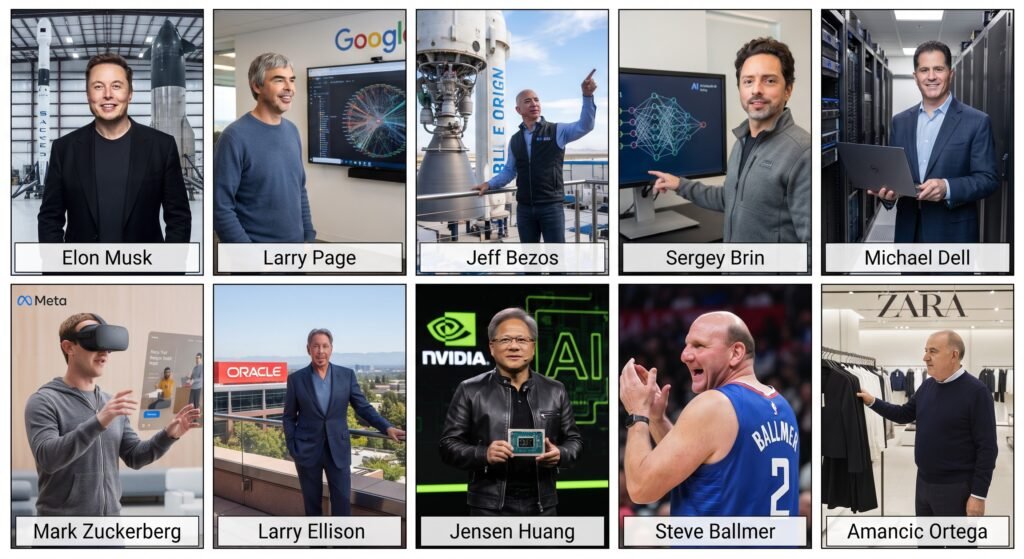
1. Elon Musk
Estimated Net Worth: ~$850 Billion+
Industry: Technology, Aerospace, Artificial Intelligence
Primary Companies: Tesla, SpaceX, xAI
How he became rich:
Elon Musk initially gained prominence as a co-founder of PayPal. However, his true wealth exploded after he reinvested his earnings into high-risk, high-reward ventures. Specifically, he founded SpaceX to revolutionize aerospace engineering and took over as CEO of Tesla, transforming the electric vehicle market. Moreover, recent surges in private space valuations and his artificial intelligence venture, xAI, have propelled him far ahead of any other billionaire on earth.
2. Larry Page
Estimated Net Worth: ~$275 Billion+
Industry: Technology & Search Engines
Primary Company: Alphabet (Google)
How he became rich:
Larry Page co-created the revolutionary Google search engine alongside Sergey Brin while they were Ph.D. students at Stanford University in 1998. As a result of organizing the world’s information, Google grew into a digital advertising powerhouse. Subsequently, under the umbrella of Alphabet, Page expanded into mobile operating systems (Android) and cloud tech, securing his multi-billion dollar legacy.
3. Jeff Bezos
Estimated Net Worth: ~$265 Billion+
Industry: E-Commerce & Cloud Computing
Primary Company: Amazon
How he became rich:
Jeff Bezos founded Amazon out of his garage in 1994 as an online bookstore. Therefore, what started as a modest digital retail experiment quickly morphed into the “Everything Store.” In addition, Bezos spearheaded the creation of Amazon Web Services (AWS), a cloud computing pioneer that generates massive profit margins. Meanwhile, his private space exploration firm, Blue Origin, continues to command significant global attention.
4. Sergey Brin
Estimated Net Worth: ~$255 Billion+
Industry: Technology & Software
Primary Company: Alphabet (Google)
How he became rich:
As the co-founder of Google, Sergey Brin built the core crawling and indexing algorithms that made web searching lightning-fast. Although he stepped down from his executive duties at Alphabet for a period, he returned to actively guide the company’s aggressive artificial intelligence strategy. Consequently, his continuous major shareholdings keep him firmly anchored at the top of the global wealth index.
5. Michael Dell
Estimated Net Worth: ~$240 Billion+
Industry: Computer Hardware & Enterprise Technology
Primary Company: Dell Technologies
How he became rich:
Michael Dell famously started building personal computers out of his University of Texas dorm room in 1984. Ultimately, he revolutionized the PC industry by pioneering a direct-to-consumer sales model that cut out middlemen. Furthermore, strategic enterprise acquisitions and robust infrastructure hardware demand have dramatically driven up his net worth over recent years.
6. Mark Zuckerberg
Estimated Net Worth: ~$195 Billion+
Industry: Social Media & Digital Platforms
Primary Company: Meta Platforms (Facebook, Instagram, WhatsApp)
How he became rich:
Mark Zuckerberg launched Facebook from his Harvard University dorm room in 2004. By connecting college campuses and expanding globally, he built the world’s largest social media network. Moreover, strategic acquisitions like Instagram and WhatsApp cemented his digital monopoly, while modern pivots toward immersive AI and digital infrastructure continue to drive Meta’s stock higher.
7. Larry Ellison
Estimated Net Worth: ~$190 Billion+
Industry: Enterprise Software & Cloud Infrastructure
Primary Company: Oracle Corporation
How he became rich:
Larry Ellison co-founded Oracle in 1977, visualizing the immense potential of relational database management systems. Over time, Oracle became the backbone software provider for major corporations, banks, and governments worldwide. Consequently, Ellison’s wealth has experienced massive recent jumps due to Oracle’s successful transition into modern cloud infrastructure and data center hosting.
8. Jensen Huang
Estimated Net Worth: ~$190 Billion
Industry: Semiconductors & AI Computing
Primary Company: Nvidia
How he became rich:
Jensen Huang co-founded Nvidia in 1993, originally focusing on high-performance graphical processing units (GPUs) for video games. However, Huang’s visionary foresight meant Nvidia hardware was uniquely positioned to handle massive parallel computing loads. As a result, Nvidia became the absolute beating heart of the global artificial intelligence boom, supplying chips to virtually every major tech giant.
9. Steve Ballmer
Estimated Net Worth: ~$155 Billion
Industry: Software & Sports Franchises
Primary Company: Microsoft
How he became rich:
Steve Ballmer joined Microsoft in 1980 as employee number 30, eventually succeeding Bill Gates as CEO from 2000 to 2014. Rather than liquidating his shares after stepping down, Ballmer chose to hold onto his massive equity stake. Therefore, Microsoft’s steady corporate growth and cloud dominance have compounded his wealth exponentially. Additionally, he owns the NBA’s Los Angeles Clippers.
10. Amancio Ortega
Estimated Net Worth: ~$148 Billion
Industry: Fashion Retail & Manufacturing
Primary Company: Inditex (Zara)
How he became rich:
Amancio Ortega co-founded Inditex—best known as the fashion retailer Zara—in 1975. Unlike traditional clothing brands that took months to design and manufacture clothes, Ortega pioneered the “fast fashion” model. Consequently, his hyper-efficient supply chain allowed Zara to replicate runway trends and put them on shelves within weeks, establishing a global retail empire.
Conclusion: What We Can Learn From the World’s Richest Titans
Analyzing the world’s top ten billionaires reveals clear recurring patterns. Ultimately, massive wealth creation stems from identifying emerging structural shifts—whether that is the dawn of the internet, the rise of social connectivity, or the explosive wave of artificial intelligence. Furthermore, long-term holding power and visionary risk tolerance separate the wealthiest individuals from the rest.
Which of these success stories surprised you the most? Drop a comment below to share your thoughts!